Exposure management vs vulnerability management: a guide
Vulnerability management starts from a list of CVEs. Exposure management starts from what is actually there, what is reachable, and who may act. A guide.
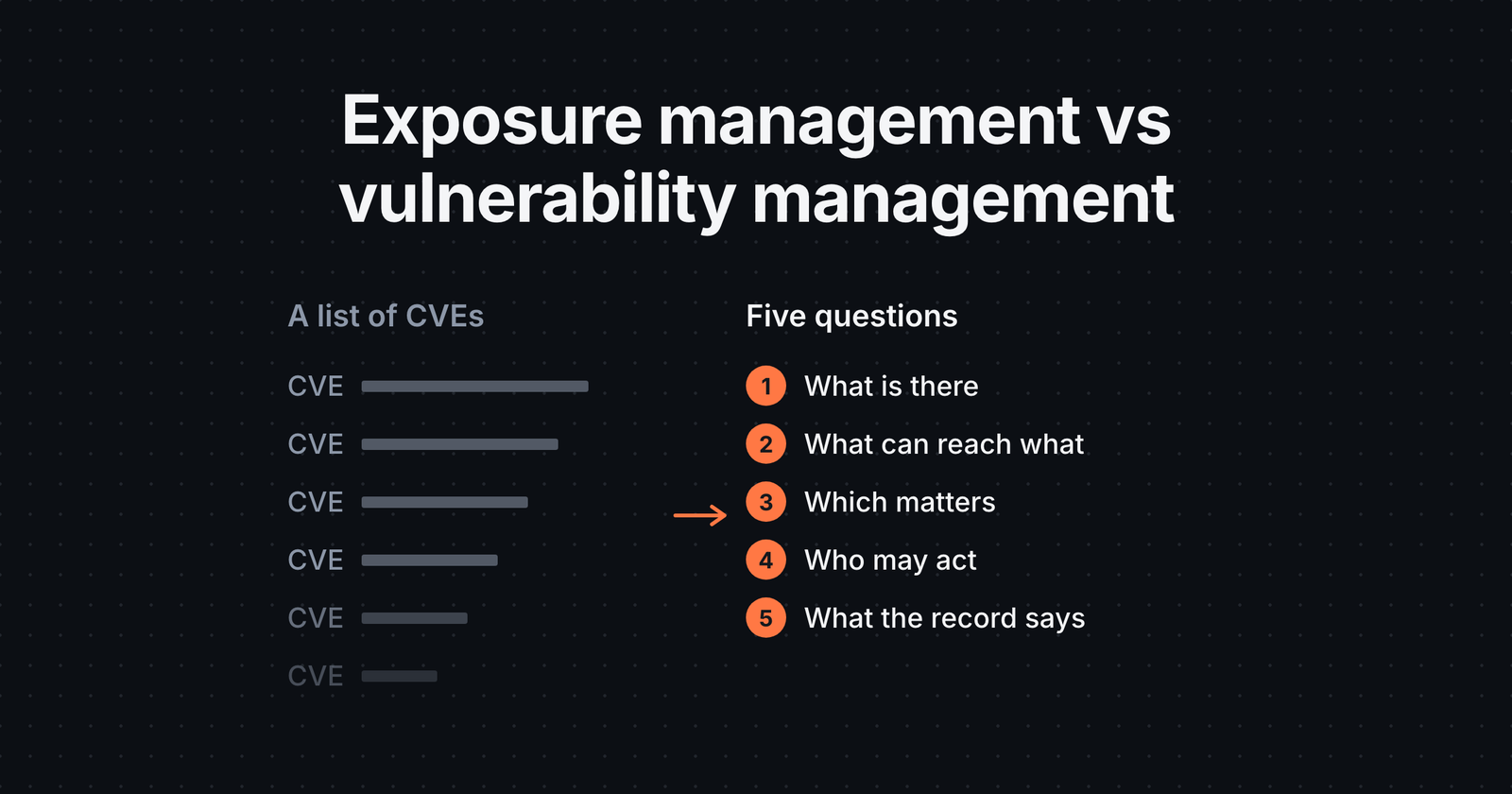
For the better part of twenty years we called the job vulnerability management. You scanned the ranges you knew about, matched the results against a CVE feed, sorted by score and sent the list to whoever owned each box. The list was long. The score came from somebody else. And the box was often not the one you thought it was.
The industry now has a different name for a bigger job. Gartner started describing continuous threat exposure management as a programme in 2022, and "exposure management" has since become the everyday term for platforms that go past scan-and-list. We didn't invent it. What we did was stop calling Kestryn a scanner and start calling it what it is. "Scanner" describes the first of five jobs and says nothing about the other four.
This post walks through those five jobs. It covers what changes when you move from vulnerability management to exposure management, how to check whether a platform really does the work, and what it takes to do all of it inside a network that isn't allowed to reach the internet.
The short version
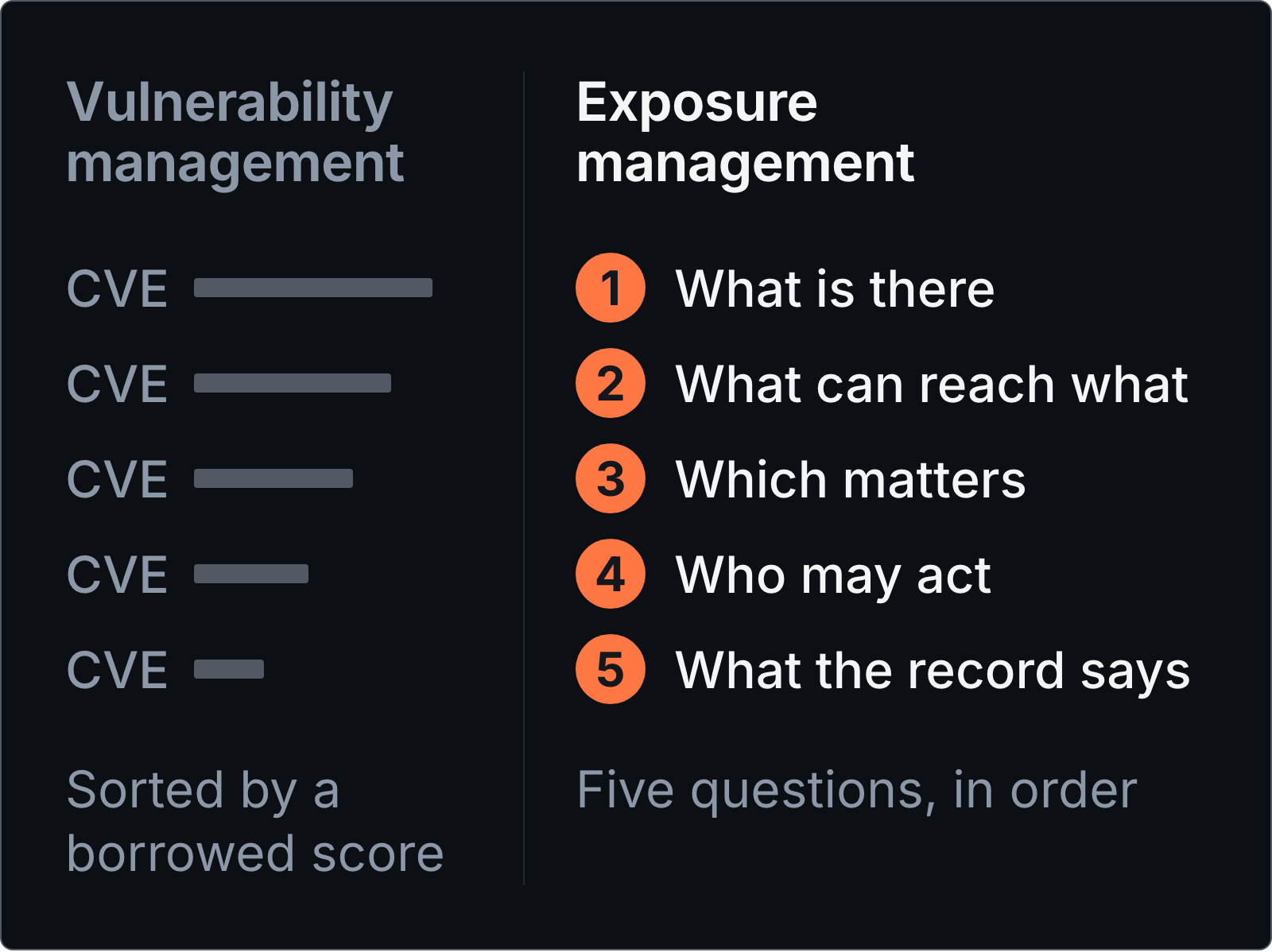
Vulnerability management begins with a list of CVEs on assets you already know about. Exposure management begins with the estate itself, and works through five questions in order:
- What is actually there? Assets with an identity that survives an address change. A list of addresses won't do.
- What can reach what? Measured, never assumed.
- Which of it matters? Ranked on evidence you can show.
- Who may act, and did they? Access is governed and every action is recorded.
- What does the record say afterwards? Each finding has a history you can audit.
A scanner answers part of question three. Exposure management covers the other four and a half.
Where vulnerability management falls short (and why the scanner isn't to blame)
Most scanners do their job well enough. The trouble lies in everything around them.
It only sees where it was pointed. A scan covers a range. An estate is whatever exists. The host that moved to a new address, the site that was offline on scan day, the machine behind a tunnel the scanner couldn't reach: none of them shows up, and the list still looks complete.
It counts addresses, and assets get lost in the count. One machine seen on two addresses turns into two findings and two tickets. Two machines that used the same address on different days collapse into one. The report shows neither mistake.
Its priority is borrowed. A severity score tells you how bad a flaw is in general. It can't tell you whether the service is reachable from anywhere that matters, whether the version match was real or guessed, or whether anybody owns the fix.
It forgets. A finding is a row in this week's export. Was it fixed last month and back again now? The export has no way to say.
It can't tell who did what. Remediation happens elsewhere, by someone, and the scanner only learns about it when the next scan comes back clean. Or doesn't.
Exposure management is the work of closing those gaps. Below is what each stage looks like done properly, and how Kestryn, our exposure-management platform, handles it wherever we can show the evidence.
1. Discovery means identity
Job one is knowing what exists. A discovery tool earns its keep by how it treats a host it has met before under another address, and by what it does with two sightings that disagree. Raw host counts tell you little.
Kestryn keys every asset to a durable identity (agent first, then hostname, then hardware address, then address) and keeps the full lease history. A host that moves to a new address keeps its history and doesn't show up as a new machine. A contradicting address creates a new asset; it is never merged in. An ambiguous attribute is disqualified and the decision is recorded, so even a mistaken merge leaves an audit trail.
Underneath sits the engine. Vestryn, written in-house, finds every live host and reads what is running on it: ports, services, product, version, OS family and hostname, with CPE identifiers passed on for CVE matching. For exposure management, the behaviour that matters most is what it declines to do. It reports a version only when the observed evidence supports one. When the evidence falls short, no version is reported and no CPE identifier is issued, which leaves CVE matching nothing to over-match on. And when a scan can't run as asked, Vestryn says so. It won't quietly narrow the scan and call it complete.
Ask your vendor: show me one machine seen four different ways, and show me what happens to the sighting that disagrees with the rest.
2. Reachability gets measured
A flaw on a service nobody can reach is a different exposure from the same flaw on a service the whole office can reach. Vulnerability management rarely tells them apart. Exposure management has to.
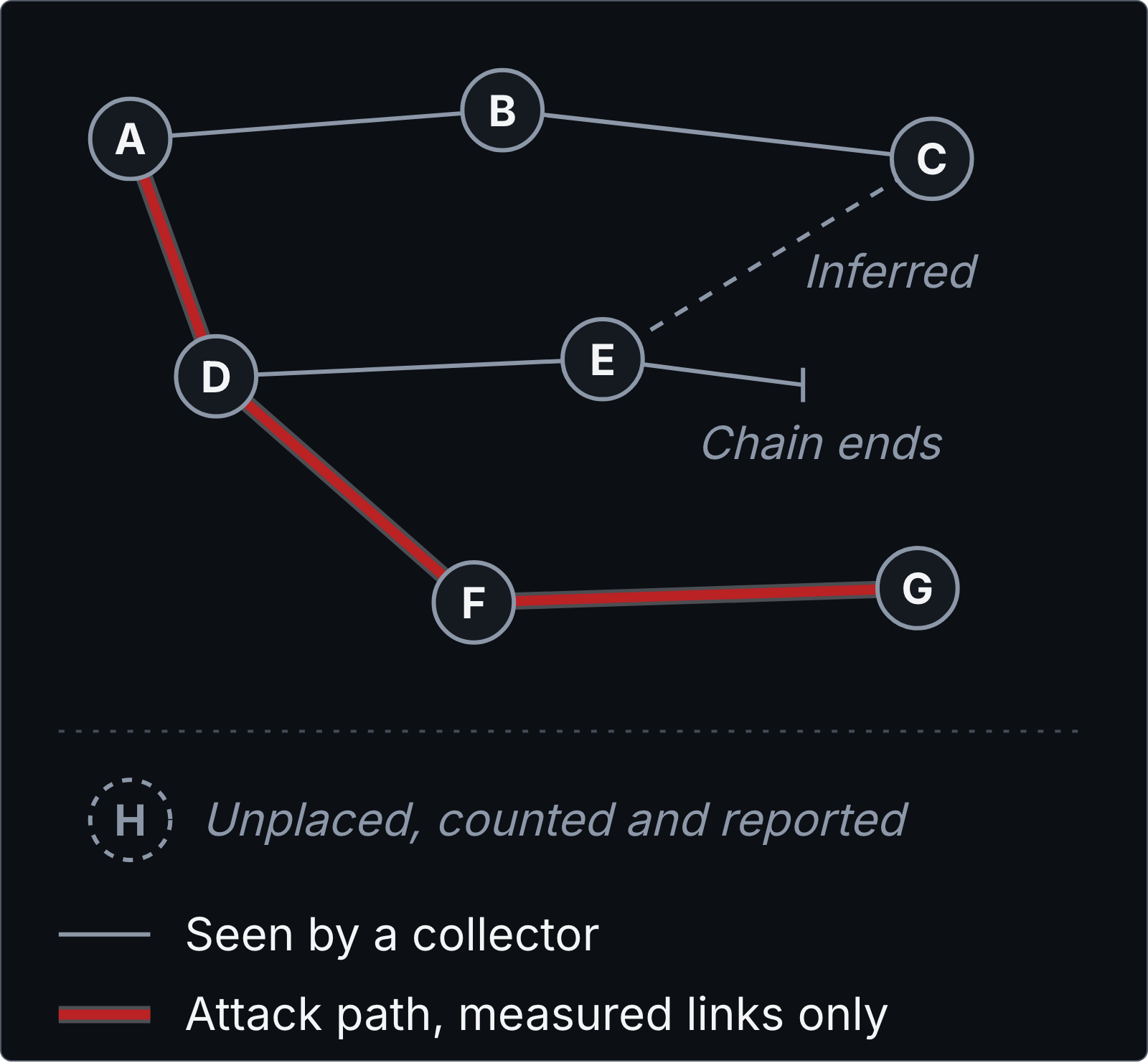
That starts with recording how every network link was observed, and whether it was measured or inferred, with the schema enforcing the difference so an inference can never be saved as a measurement. Kestryn works this way. On its map, solid lines were seen by a collector. The one dashed line is an inference, shown on request and never counted. Where something didn't answer, the chain simply ends. Kestryn won't draw a link across the gap. A host that can't be placed on a known segment is counted and reported as unplaced, so the hole in coverage stays in view. Attack paths run only over measured links, and each path is itself labelled as an inference drawn from them.
Ask your vendor: which lines on your map were measured and which were inferred? Can I tell them apart in the data, or only in the picture?
3. Priority you can defend
Prioritisation is where most exposure-management marketing lives, and where most of it can't be checked. Doing it well is unglamorous work. Keep every score you have from every source you have, side by side, record where each one came from, and never let a guessed version turn into a confident match.
Kestryn enriches CVEs from multiple feeds, the CISA KEV catalogue among them, each on its own schedule, and operators can import files too. It prioritises on CVSS v3.1, v3.0 and v2, keeping all of them at once from multiple sources. That restraint further up the chain (no version, no CPE identifier, no match) is what makes the ranking worth trusting.
If an AI layer reasons over those records, hold it to the same standard as the map. Prospica, the governed intelligence layer of the Appdirs platform, reasons over what Kestryn recorded, cites what it used and keeps its own reasoning on the record. A confidence that came from the model is recorded as the model's, never presented as calibrated. Prospica has no tools of its own, and every consequential action waits for a person. Vulnerability triage with deterministic scoring, through governed tools, is one of its use cases. Finance, HR and others run on the same governed core.
Ask your vendor: for this finding, which feed did it come from, which score version applies, and was the version match backed by evidence or guessed?
4. Someone may act, and the record says who
A finding with no accountable owner is just a report. For an exposure programme to work, two things must hold. The platform has to drive the fix, and the right to act has to be governed.
Kestryn is built to find, explain, prioritise and drive the fix, with every step grounded in evidence and an auditable trail. It integrates with email, collaboration tools, SIEM, service management and issue trackers, plus a generic authenticated endpoint. Access control is enforced on the server, and the interface is treated as presentation only. Single sign-on runs through Appdirs AuthX, switched on by configuration. AuthX decides who and what may act, with one identity store, one role model and one append-only audit trail across the applications, servers, network devices and machine identities it governs.
Scanning is an action as well, and it needs governing too. In Kestryn, a per-zone traffic cap governs every concurrent scan across the estate. Site exclusions are set per network segment, and no campaign, schedule or operator can override them at run time. If a scan can't reach its governor, it doesn't run at all. Intrusive checks ship switched off and need two separate authorisations to turn on.
Ask your vendor: who authorised this scan, who was allowed to act on this finding, and where is that written down?
5. Every finding has a history you can audit
The last job is the one auditors care about. A finding should move through open, reopened, fixed and resolved, with first-seen and last-seen times. If it turns up again after a fix, it should reopen. Leaving it quietly closed hides the problem. Kestryn keeps that whole lifecycle, reopening on redetect. Each scan's run header records that the run was authorised, and that it actually finished. A scan that was cut short can't pass itself off as complete.
Where the operational record lives matters as well. Kestryn sends its audit and server logs to ORCA, our self-hosted messaging and notification platform. ORCA parses the logs, folds alert storms into single incidents and keeps every dispatch on the record.
Ask your vendor: show me a finding that was fixed and came back, and the row that says so.
The hard part: doing it all inside the perimeter
All of this gets harder when the estate is sovereign, regulated or disconnected, and that describes most of the estates that need it. Cloud-hosted exposure platforms assume your network can reach them. Plenty can't, and some must never.
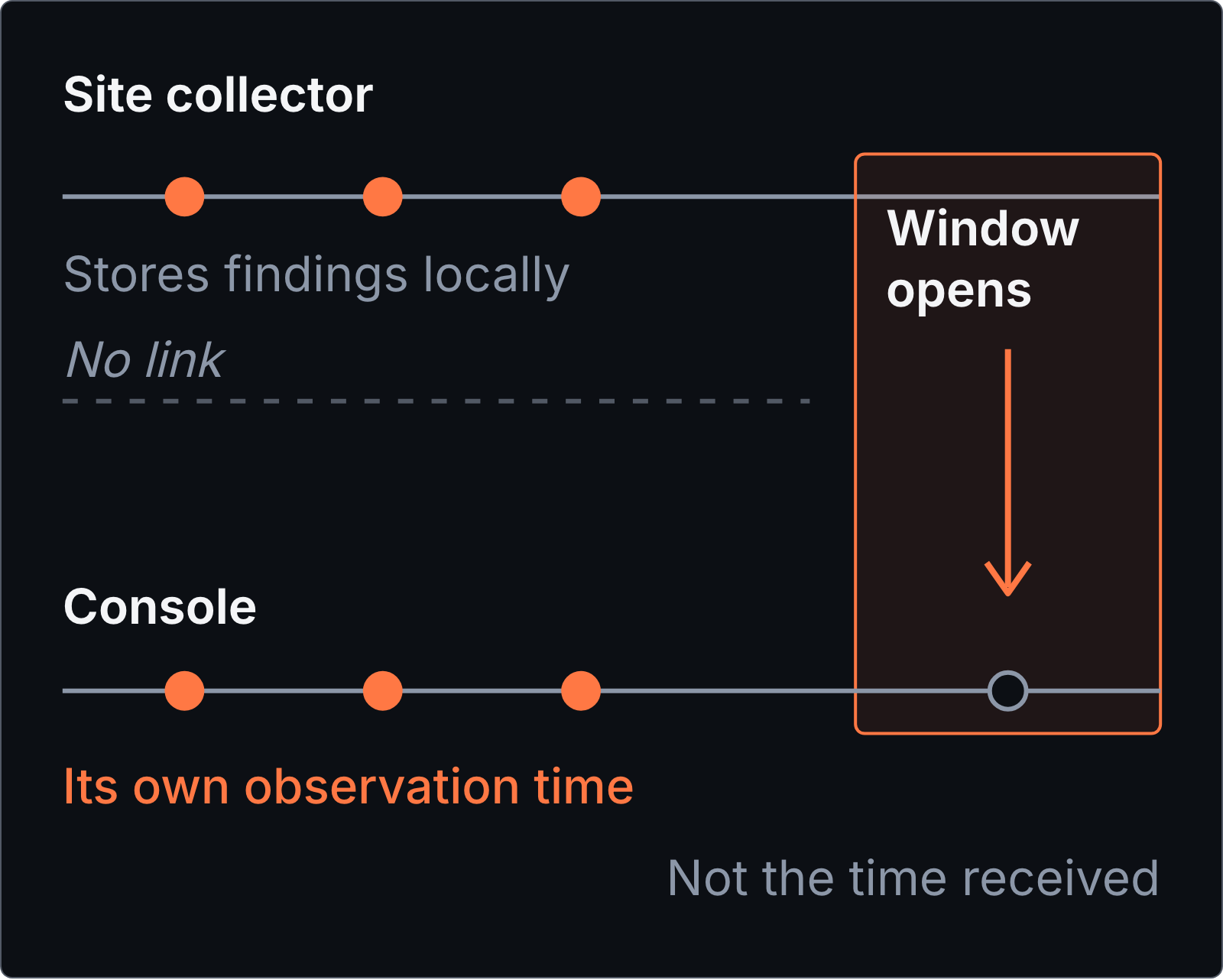
Kestryn is built for sovereign and disconnected networks and runs wholly inside your perimeter. It deploys wholly on-premise, with no external call in any product path, as native operating-system packages on hosts you provide. Site collectors work from a cached, signed scan policy and keep sweeping with no link at all. They store findings locally and send them on when a window opens. A site that reconnects after months reports what it saw back then, stamped with its own observation time and never the time the console received it. In sovereign mode every external model and tool call is disabled, enforced in code and not by policy, as a runtime check in the call path.
Every Appdirs product can be deployed air-gapped in your infrastructure or as SaaS, depending on your use case. For exposure management, evaluate the air-gapped shape first. It's the only real proof that the on-premise version has no hidden dependency.
A maturity path you can use on Monday
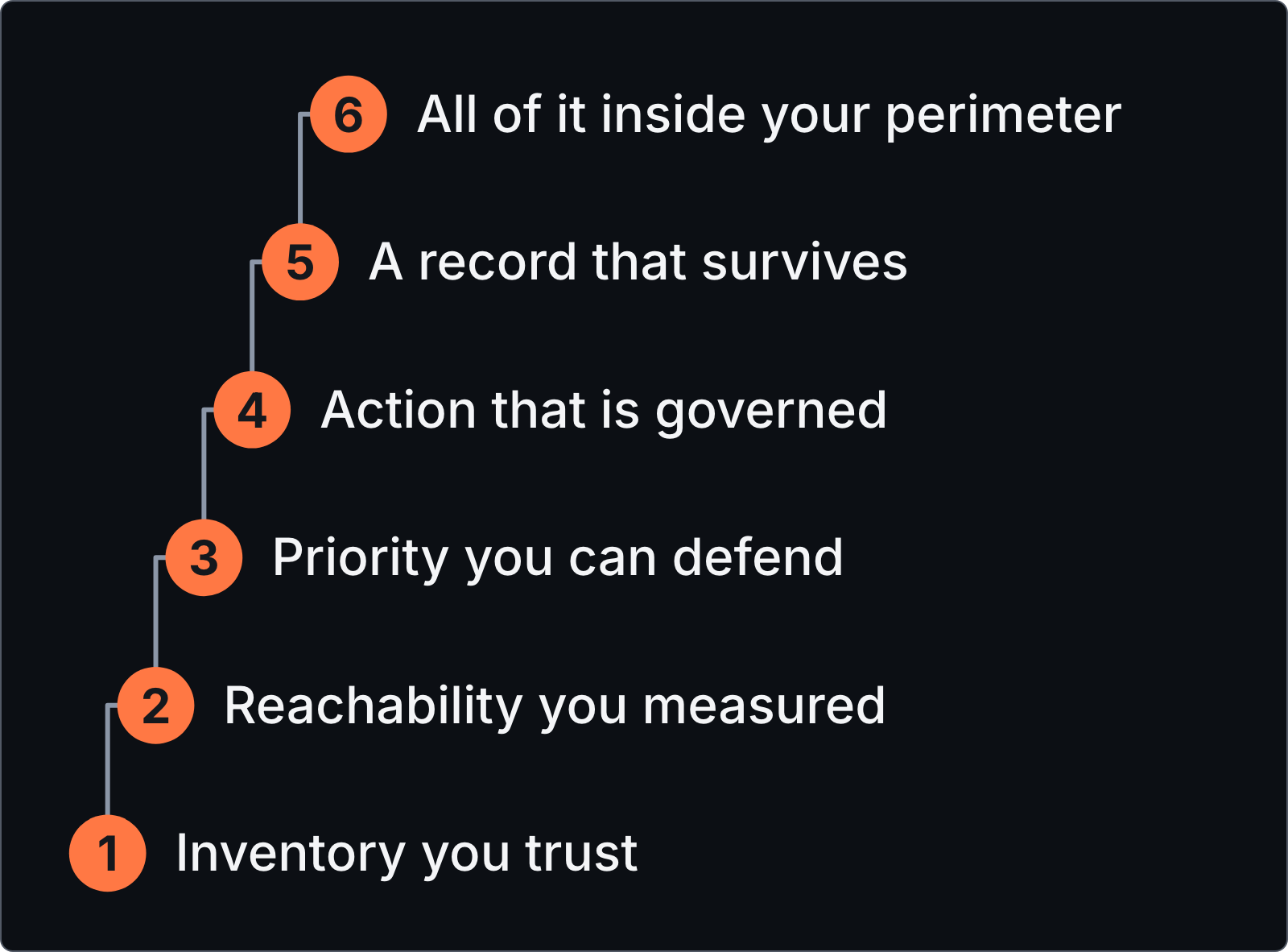
| Stage | You have it when | You don't have it yet when |
|---|---|---|
| 1. Inventory you trust | An asset keeps its history across an address change, and contradictions stay visible | The asset count changes every scan and nobody knows why |
| 2. Reachability you measured | Every link says how it was observed, and unplaced hosts are counted | The map is drawn from assumptions and looks complete |
| 3. Priority you can defend | Each finding names its feed, its score version and whether the version match was evidenced | One borrowed score sorts everything |
| 4. Action that is governed | Who may act is enforced on the server, and scans refuse to run ungoverned | Anyone with console access can scan anything, any time |
| 5. A record that survives | Findings reopen on redetect, and runs record authorisation and completion | Last month's export is the only history |
| 6. All of it inside your perimeter | Collectors keep working with no link, and nothing in the product path calls out | "On-premise" still leans on a licence server, a model API and a feed you can't see |
Where to go next
To see how the products fit together, start with the platform overview. To see Kestryn running on your own hardware, on a segment with no route out, request an evaluation. Or request a demo, and we'll walk through the five stages against your estate.